The inter-agent economy: when broker agents talk to carrier agents
When a broker’s AI agent can negotiate directly with a carrier’s underwriting agent, the back-and-forth that slows commercial insurance can shrink from days to minutes.
Thought Leadership

An inter-agent economy is one where AI agents acting for different parties, such as a broker and a carrier, communicate and negotiate with each other directly. In commercial insurance, that means fewer rounds of requests and replies between people and a faster path from submission to bind.
In my previous article, I explored the rise of the agentic underwriting ecosystem, the shift from passive AI tools to autonomous agents that can reason, plan, and execute. But there is a second act to this transformation that will fundamentally rewrite the rules of the commercial insurance marketplace.
We are moving toward an inter-agent economy. Today, the friction in commercial insurance isn’t just a technology problem; it is a communication problem. A broker sends a submission, a carrier asks for more data, the broker fetches it, and the cycle repeats. Even with modern APIs, the “human middleware” is often bogged down by administrative ping-pong.
From APIs to autonomous negotiations
In an inter-agent economy, we move beyond simple data exchange. We enter the realm of agent-to-agent (A2A) orchestration. Imagine a world where a broker’s AI agent does not just fill out a form, but actively “advocates” for a risk. It packages the submission, anticipates the carrier agent’s questions, and provides real-time clarifications. On the other side, the carrier’s underwriting agent assesses the risk against appetite in milliseconds.
When these two autonomous systems interact, three things happen:
- Semantic harmony: Instead of worrying if Field A matches Field B, agents understand the intent of the data. They can translate a “General Liability” description from a broker’s system into the specific “Risk Class” required by a carrier’s internal model without manual mapping.
- Instantaneous triage: The carrier agent can “interview” the broker agent. “Does this location have a central station fire alarm?” The broker agent queries the digital file, confirms the answer, and provides the documentation, all before a human even opens the email.
- The death of the “submission black hole”: We move from a quote-to-bind cycle measured in days to one measured in minutes.
The role of the “intelligence switchboard”
For this economy to function, we cannot have a “Wild West” of uncoordinated bots. We need centralized infrastructure: an intelligence switchboard. This is where the ecosystem concept becomes vital. Platforms that sit at the intersection of distribution and underwriting, like Bold Penguin, serve as the trusted layer where these agents meet. This layer provides the “rules of engagement,” ensuring that data is secure, permissions are respected, and the agents are speaking a standardized logic.
Why this matters for the human underwriter
Does a world of A2A communication leave the human underwriter behind? Quite the opposite.
By allowing agents to handle the administrative negotiation, the human underwriter is elevated to the role of Chief Arbitrator. You are not checking boxes; you are managing the parameters of the agent, handling the complex “edge cases” that require true human judgment, and focusing on high-level relationship management.
The inter-agent economy in practice
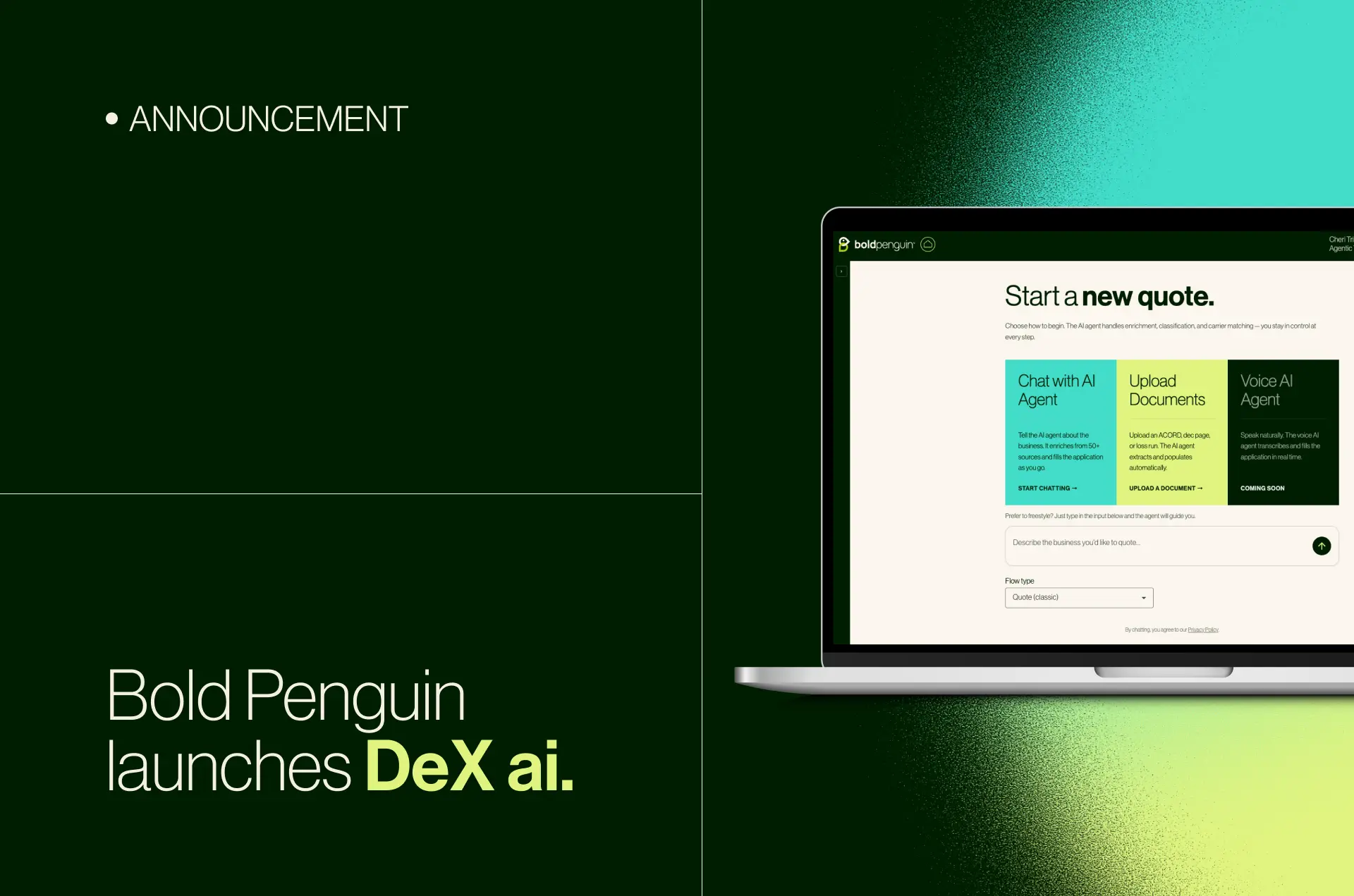
Since I first wrote about this on LinkedIn, two developments show how quickly it is taking shape. Bold Penguin launched DeX ai and opened the infrastructure behind its own solutions to carriers and brokers through APIs, an MCP server, and agent-to-agent connections. And in September, Thimble and Bold Penguin announced an integration that lets brokers request small business quotes in natural language, with the two systems discovering each other and carrying out quoting tasks using agent-to-agent technology.
In the months since outlining this inter-agent vision, DeX ai has effectively mastered lane matching, capacity intake, and real-time quoting. However, routine A2A (agent-to-agent) negotiation has not crossed the finish line primarily because closing a deal requires shared protocol standards, legal accountability, and machine-level trust that the insurance industry’s fragmented ecosystem has not yet standardized. Moving from automated administrative triage to legitimate algorithmic deal execution will require dynamic counterparty verification and transparent guardrails that let operators delegate binding contractual authority with complete confidence.
The future is collaborative
The next frontier of insurance isn’t just “AI-powered.” It is networked intelligence. The winners won’t just be those with the best internal AI, but those whose agents are the most “collaborative,” capable of seamlessly interacting with the rest of the ecosystem to find the best match.
The question is no longer: Is your firm using AI? The question is: Is your AI ready to negotiate?
Adapted from Nilesh Dambe’s original post on LinkedIn, first published in April 2026.
INSIGHTS